Longevity in the GLP-1 Era: GLP-1 and Aging

For years, weight-loss and wellness advice treated the body like a simple math problem: eat less, move more, repeat.
Meanwhile, “health” and “longevity” lived in a separate conversation.
That old model is officially outdated.
We’ve entered the Weight Health Era — and it’s transforming how we think about metabolism, longevity, when and how to use GLP-1 medications strategically.
What’s driving this shift is something most of us were never taught.
Your weight-health hormones — not your willpower, macros, or even medications — regulate the systems that determine whether you age well.
These hormones govern appetite, digestion, nutrient utilization, blood sugar, inflammation, fat metabolism, and muscle preservation — the core pillars of longevity.
And until very recently, they were absent from almost every conversation about weight, metabolism, and aging.
Now, thanks to GLP-1 medications — synthetic, longer-lasting versions of two of your body’s own hormones (GLP-1 and GIP) — we finally have a window into just how central they are to optimal health.
So, let’s take a closer look at what actually controls your ability to age well, and where low-dose or microdosed GLP-1 agonists fit.
Longevity Starts with a Functioning Ecosystem
Your body is not a machine. It’s an ecosystem — constantly sensing, adjusting, and responding to inputs.
Food, movement, sleep, recovery, hydration, stress patterns, supplements, and medications influence how your internal signals function.
That’s weight health: how well your body functions, not how much it weighs.
Longevity simply means your ecosystem has what it needs, when it needs it — and can use it well.
You need:
- adequate lean muscle
- appropriate fat stores
- strong bone turnover
- stable blood sugar
- efficient digestion and motility
- low, well-regulated inflammation
These aren’t nice-to-haves. They’re the physiological cornerstones of aging well.
And they are regulated by your weight-health hormones.
This is the part almost no one was talking about — until GLP-1 medications made their role impossible to ignore.
Meet Your Weight-Health Hormones: The Longevity Regulators
These are your body’s built-in “metabolic maestros.” Primarily produced in your gut lining, your weight-health hormones coordinate appetite, digestion, blood sugar, tissue repair, inflammation, fat metabolism, and muscle maintenance.
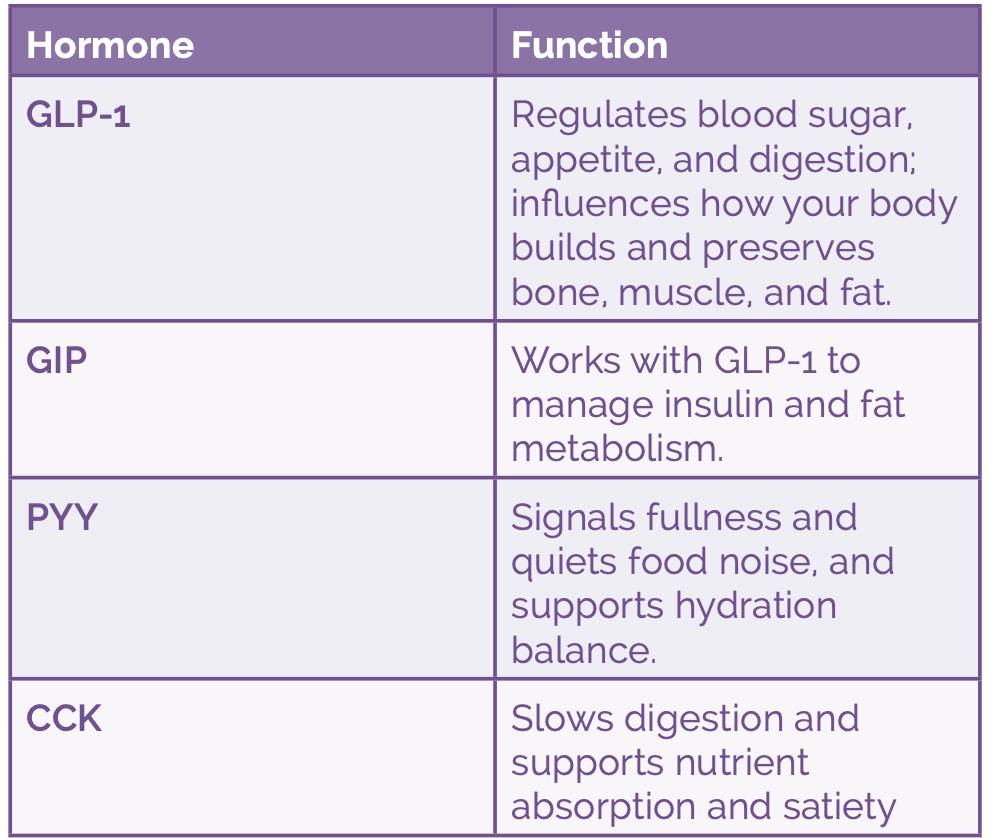
What Happens When These Signals Are Suboptimal?
When weight-health hormones are firing:
- Energy is steady
- Cravings quiet
- Metabolism stays flexible
- Digestion feels smooth
- You can build (and keep) lean tissue
When they misfire?
- Constant hunger
- Energy crashes
- Sluggish digestion
- Worsening cravings
- Difficulty building or maintaining muscle
- Weight regain (even on GLP-1 medications)
This is where people often mistakenly blame themselves instead of their hormone signaling.
The good news is that when any of these signals show up, you can support your body.
The GLP-1 Revelation: A Missing System Comes Into View
GLP-1 agonists (like semaglutide and tirzepatide) work precisely because they replace or reinforce two of your weight-health hormones.
That’s why, for the first time, the world is seeing how powerful these signals really are.
What GLP-1 agonists do:
- Stay active for far longer ( day(s) vs. minutes)
- Suppress appetite and slow digestion
- Improve blood sugar regulation
- Reduce inflammation
- Aid weight reduction
What they don’t do:
- Repair your gut
- Optimize nutrient levels
- Fix stress-hormone imbalances
- Improve sleep hygiene
- Build muscle
- Optimize mitochondrial function
- Teach your own weight-health hormones to perform better
And that’s why we now understand something crucial: You just can’t medicate your way to longevity if your weight-health hormones aren’t functioning well.
But here’s the nuance.
Microdosing: Powerful When the System Works, Problematic When It Doesn’t
Microdosing is the “just a whisper” version of GLP-1 therapy — a lighter dose meant to support, not overpower. It works beautifully when the ecosystem is strong, but highlights signaling dysfunction when it’s not.
When weight-health hormones are already underperforming, microdosing may lead to:
- appetite that’s too low and rebound hunger later
- digestion that slows without improved satiety
- muscle and hair loss from chronic under-fueling
- unsettled blood sugar
- plateaus that don’t budge
- inconsistent symptoms dose-to-dose
Microdosing lowers the intensity of the signal. It doesn’t repair the system generating the signal.
Which brings us to the 2-part plan supported by evidence.
The Weight-Health Hormone Plan for Longevity
Whenever you see signs of suboptimal function, your approach now has two steps:
1. Optimize your internal weight-health hormone function (non-negotiable).
This is the foundation — and where longevity is actually built.
Optimization requires:
- Fiber plus phytonutrients to activate gut-derived hormones
- Optimal protein, specific amino acids for muscle and metabolic repair
- Digestive support for motility and nutrient absorption
- Daily hydration + electrolytes
- Structured sleep architecture
- Stress-pattern recalibration
- Resistance training to activate GLP-1, GIP, and CCK signaling
- Metabolic “pit stops” — optimally resourcing (total nutrition, hydration, movement, stress reduction, or recovery).
There is no “perfect” diet. There is only what helps your body run better today and tomorrow.
2. Add a micro or low-dose GLP-1 agonist (optional and powerful when used correctly).
When used with ecosystem optimization, low-dose agonists can:
- reinforce satiety
- improve metabolic timing
- quiet food noise
- optimize blood sugar and inflammatory response
- support sustainable body composition shifts
- complement your own hormones instead of replacing them
Used without optimization, they can amplify dysfunction. Used with optimization, they can amplify longevity.
Your Best Shot: The Playbook for the Weight-Health Hormone Era
This is exactly why I wrote Your Best Shot: The Personalized System for Optimal Weight Health — GLP-1 Shot or Not.
It’s the first framework that teaches you how to:
- meet your weight-health hormones and their role in weight health optimization
- assess their operations to identify suboptimal function
- restore function with daily ecosystem inputs your hormones need
- personalize your total nutrition for metabolic longevity
- if you choose, use micro/low-dose GLP-1 strategically — or transition off safely
- protect the systems that determine how well you age
As Dr. Lipman puts it:
“With growing interest in GLP-1 therapies and weight-health hormones, it’s more important than ever to have a guide you can trust. Your Best Shot is that guide: thorough, precise, compassionate. Ashley Koff RD gives you more than just protocols — she gives you the tools to understand your own body and to choose what works best for you.”
The Longevity Bottom Line
Whether you’re using a GLP-1 agonist, microdosing, tapering, or avoiding medication altogether, your path to aging well comes down to one principle: Longevity is an ecosystem that has what it needs, when it needs it — and can use it well.
That’s weight-health hormone function.
Your body is talking. Let’s make sure you know how to listen and how to respond. That’s your best shot at living longer and healthier.
Ashley Koff, RD, is the author of Your Best Shot: The Personalized System for Optimal Weight Health — GLP-1 Shot or Not and the Founder of The Better Nutrition Program.